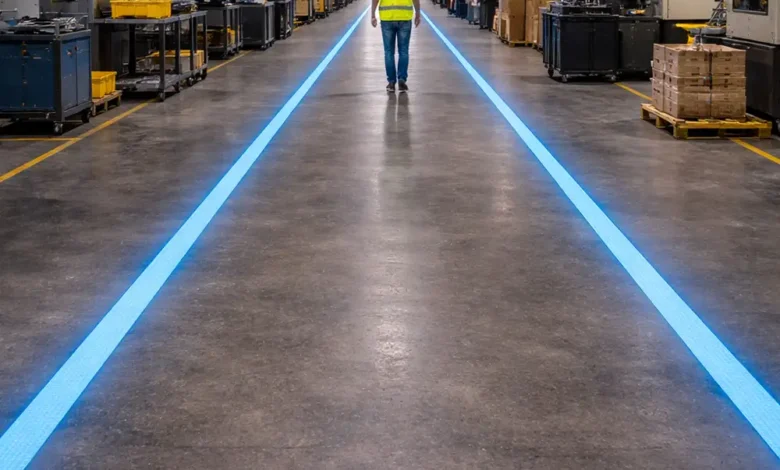
In industrial boundary marking and precision alignment work, a sharp, high-contrast laser line makes all the difference. Whether a warehouse uses linear laser projector to mark forklift safety zones, a factory aligns production machinery, or an overhead crane projects hazard boundaries onto the floor, beam focusing performance and long-distance visibility directly impact both workplace safety and operational efficiency. Yet most standard line lasers on the market share a critical limitation: usable clarity drops off sharply beyond short to medium distances.
Standard entry-level to mid-range line lights deliver acceptably sharp lines at 6 to 10 meters, but once projection distance exceeds that range, the line grows faint, washed out and difficult to see from a distance. For high-ceiling warehouses, tall crane bays and large production halls that require 15 to 20 meter throw distances, this performance gap leaves facilities with weak, unreliable marking that fails to meet safety visibility standards.
As an industrial projection brand built by Shenzhen Aladdin Lighting Technology Co., Ltd., Noparde set out to fix this gap. Its engineering team redesigned the optical path from the laser diode outward, building an upgraded beam condensing system for its industrial line laser projectors that maintains sharp, high-brightness lines far beyond the range of standard single-lens models.
This is how Noparde upgraded its beam-focusing technology to deliver clearer, brighter and more consistent linear marking at real-world long working distances.
The Engineering Challenge: Why Ordinary Line Lasers Lose Visibility at Long Range
A typical standard line laser uses a single cylindrical lens to spread a laser dot into a straight line. The design is simple and low-cost, but it comes with inherent optical limits that become obvious in industrial settings — most notably, it can only maintain usable clarity within 6 to 10 meters. Past 10 meters, beam divergence causes rapid brightness loss, and by 15 meters the line is often too faint to serve as a reliable safety marker.
Three core flaws drive this poor long-distance performance:
- Uneven brightness from end to end Because the original laser beam follows a Gaussian energy distribution — bright in the center, fading toward the edges — the projected line follows the same pattern: strong in the middle, noticeably dimmer at both ends. This effect worsens as distance increases. In safety marking scenarios, dim line ends mean workers near the edge of a zone may not see the boundary clearly.
- High beam divergence and rapid width growth Without proper optical collimation, the line widens quickly as projection distance increases. A line that is 2 cm wide at 3 meters can blow out to 10 cm or more at 10 meters, losing precision and blending into the floor. At 15 meters and beyond, the line becomes so wide and diffuse that it no longer functions as a sharp boundary marker.
- Poor edge definition at range Basic cylindrical lenses produce soft, blurred line edges instead of sharp boundaries. For warehouse aisle marking and equipment positioning, fuzzy lines reduce the usefulness of the marker as a clear visual reference — and at longer distances, that blur turns into a faint glow that workers can barely distinguish from ambient light.
For industrial customers running large facilities, these are not minor optical details — they are real visibility problems that weaken safety marking and alignment accuracy. Noparde’s goal was straightforward: build a linear laser positioning light with upgraded condensing optics that keeps lines sharp and bright at 15 to 20 meters, far beyond the reach of standard market models.
The Noparde Technical Solution: Three Focus-Upgrade Designs
To improve beam focus and line quality, Noparde’s optical team rebuilt the light engine around three core upgrades, replacing the simple single-lens approach with a multi-stage focusing system.
1. Powell Lens Uniform Beam Shaping
Instead of a basic cylindrical lens, Noparde uses a precision Powell lens beam-shaping system to redistribute laser energy across the full length of the line. Instead of the usual bright-center, dim-edges Gaussian profile, the lens spreads light evenly so the entire line has nearly identical brightness from one end to the other.
This eliminates the “hot spot” in the middle and brings both end sections up to full intensity. For workers walking along a warehouse aisle, the line looks equally clear whether they stand near the center or near the end of the projection.
2. Pre-Collimation Focusing Optical Group
Before the beam reaches the line-shaping lens, it first passes through a multi-element collimating lens group that compresses beam divergence and tightens the light into a parallel beam. This is what gives Noparde’s industrial line laser projector its stronger focusing performance.
By collimating the beam early, the system keeps line width much more stable as distance increases. Compared with standard line lights of the same power, Noparde units produce a narrower, more concentrated line at the same working distance, and therefore deliver higher surface brightness and sharper edges. In practical terms, the line stays crisp and visible at 15–20 meters instead of spreading into a wide, washed-out band.
3. Precision Focus Locking Mechanism
Even the best optics do not help if the focus drifts after installation. Noparde’s linear projectors use a threaded focus ring with a locking structure, so once the line width is tuned on site, it stays set. The heavy-duty housing also resists vibration from forklift traffic, overhead crane movement and factory machinery, preventing focus shift caused by constant shaking.
This is especially important for permanent installations in warehouses and production plants, where equipment runs for years with little routine adjustment.
Noparde’s Technical Strength, Custom Capability and Customer Commitment
Behind this optical upgrade is Noparde’s long-standing approach to product development: build for real industrial conditions, not just lab spec sheets. The brand does not inflate distance ratings that only look good on paper; every optical configuration is tested at actual working distances to make sure line quality holds up in real facilities.
This same practical mindset extends to its custom service. Noparde does not sell only one fixed line laser for every job. Its technical team works directly with customers to match projection ratio, line width, wavelength color and mounting style to each site — whether the project is narrow aisle marking in a small warehouse, long-distance crane warning lines in a steel plant, or precision alignment lines on an automated production line. Custom gobo lens patterns and multi-line combinations are also available for more complex safety layouts. For Noparde, responsibility means delivering a solution that performs as expected on day one and stays consistent for years afterward.
The Result: Sharper, Brighter Lines That Hold Up at Distance
With the upgraded focusing system, Noparde’s linear laser projectors set a higher bar for industrial line marking performance.
- Stronger beam focus and longer clear range: Compared with standard single-lens line lights of the same power class, which only maintain clear visibility at 6–10 meters, Noparde projectors deliver crisp, high-brightness lines at 15–20 meters. Less light spreads wastefully, and more of it stays concentrated in the line itself.
- Superior end-to-end uniformity: The Powell lens design brings brightness uniformity above 85% across the full line length, eliminating the dim-end problem common to basic cylindrical-lens models.
- Stable line width at extended range: The collimated optical path keeps line width growth under control at longer distances, making the units suitable for high-ceiling warehouses, overhead crane bays and large production halls where basic line lasers would already look too wide and faint.
- Longer usable service life: Tighter focus and better thermal management also reduce stress on the laser diode, supporting a rated service life of 50,000 hours and lowering long-term replacement costs for facility operators.
Proven in Real Industrial Environments
This focusing upgrade has already been validated in demanding sites across Europe and North America. In a large Polish logistics warehouse, for example, Noparde linear boundary laser projectors were installed at 10-meter mounting heights to mark forklift and pedestrian zones. The lines stayed sharp and evenly bright along the full length of the aisle, and workers could clearly see boundaries from far away even under 3000+ lux warehouse lighting.
In heavy manufacturing plants, the vibration-resistant focus lock has kept line width stable month after month, even when mounted near heavy machinery and overhead crane runways.
With multiple optical patents and strict ISO9001 quality controls, Noparde shows that a better industrial line laser is not just about more raw power — it is about smarter optics that put more of that power exactly where it is needed.
Closing: Built for Precision, Built for the Real World
At the end of the day, Noparde’s work to improve beam focus is about more than optical performance — it is a reflection of the brand’s core responsibility to its customers. Too many industrial line lasers look good in a product photo but deliver blurry, faint lines once installed at real working heights, leaving facilities with weaker safety marking than they expected.
Noparde avoids that by engineering focusing, uniformity and mechanical stability into every unit, and by tailoring each configuration to the customer’s actual site conditions. From Powell lens beam shaping to custom projection ratios and on-request line width tuning, the brand gives industrial clients not just an off-the-shelf laser light, but a reliable long-term marking solution that stays sharp, bright and consistent year after year. That combination of optical depth and customer-focused service is what sets Noparde apart in the industrial projection market.
About Noparde
Founded in 2017, Noparde is a global projection lighting brand operated by Shenzhen Aladdin Lighting Technology Co., Ltd. The brand specializes in custom gobo projectors, industrial safety projection systems and large-scale municipal engineering lights, serving more than 200,000 users in over 50 countries.